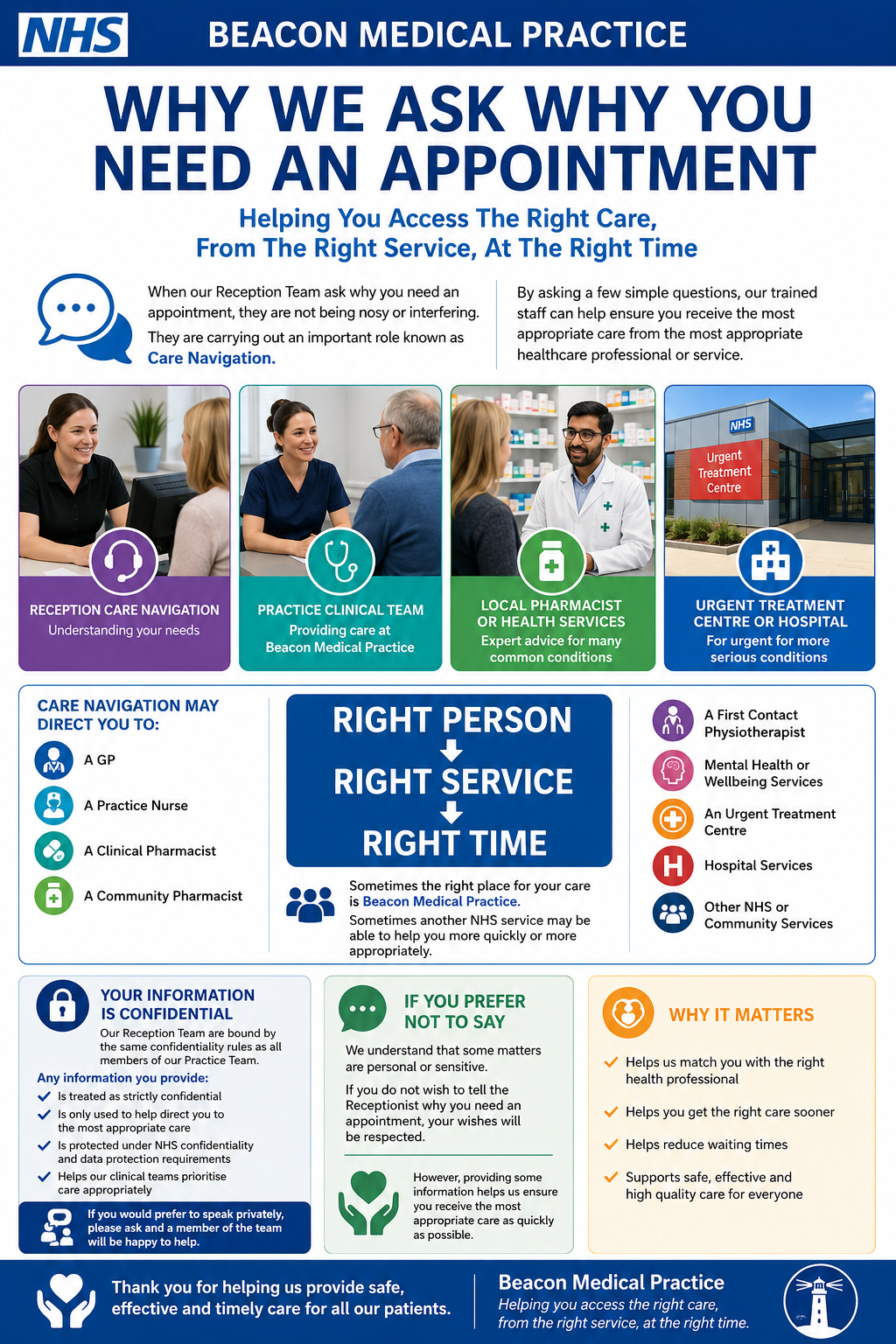
Before booking an appointment with a General Practitioner or Clinical Practitioner, please consider whether one of the options below may be more appropriate.
These services can help with a wide range of common medical problems and often provide faster access to advice or treatment.
Self‑Care for Minor Illnesses
Many everyday conditions — such as coughs, colds, sore throats, headaches, stomach upsets and minor aches — can be safely managed at home.
Supporting self‑care helps free up GP appointments for patients with more serious or complex needs, making it easier for everyone to access the right care at the right time.
Pharmacy First: Fast, Expert Help Without a GP Appointment
Almost all pharmacies now offer the Pharmacy First service. Pharmacists are highly trained healthcare professionals who can provide confidential advice and, where appropriate, supply NHS medicines for seven common conditions, without needing to see a GP.
Pharmacy First can treat:
- Sinusitis – ages 12+
- Sore throat – ages 5+
- Earache (acute otitis media) – ages 1–17
- Infected insect bites – ages 1+
- Impetigo – ages 1+
- Shingles – ages 18+
- Uncomplicated UTIs – women aged 16–64
Pharmacists can also advise whether you need to see a doctor or nurse. For coughs, colds, aches and pains, you can simply walk in — no appointment needed.
NHS 111: Urgent Advice When You’re Not Sure What to Do
NHS 111 is the free, non‑emergency NHS helpline. It is available 24/7 and can provide urgent medical advice, reassurance and direction to the most appropriate service.
Use NHS 111 if:
- you need medical help fast but it’s not a 999 emergency
- you think you may need A&E or urgent care
- you’re unsure who to contact
- you don’t have a GP to call
- you need reliable health information or reassurance
NHS 111 can also book you into an urgent treatment centre or A&E slot if needed.
Get help for your symptoms – NHS 111
A&E: For Life‑Threatening Emergencies Only
A&E should only be used for life‑threatening accidents or emergencies. Before attending, consider whether another service may be more appropriate.
The NHS now uses NHS 111 First, which helps ensure you are directed to the right place and reduces waiting times.
You can read more about this system on the Health Watch website.
Home | Healthwatch Lincolnshire